

The short answer
Workers got more productive whether the lights went up or down. The variable that mattered was that they were being watched. Here’s the real story behind the Hawthorne effect, what the famous study got wrong, and how to leverage the effect on for your own commitments and habit building (or breaking)!
You don't have a discipline problem. You have an audience problem.
Put a stranger in the room and watch what happens. Your posture straightens. Your phone flips face down. And that work you've been dodging for three days? Suddenly done. Your talent didn't change. Your aims didn't change. Someone started watching.
Scientists have a name for this. It's one of the most famous ideas in psychology, and it was born in, of all places, a telephone factory.
What is the Hawthorne effect?
The Hawthorne effect is the tendency of people to change their behavior, usually for the better, when they know they're being observed.
Workers produce more when the boss walks the floor. Drivers suddenly respect the speed limit when a patrol car sits in the median. The gym bro lifts heavier when the cute stranger is on the next bench. I saw it firsthand when I put an insurance sensor in my car that monitored my driving behavior.
Same person. Same ability. New audience.
And the story of how this thing got its name is weirder than the effect itself.
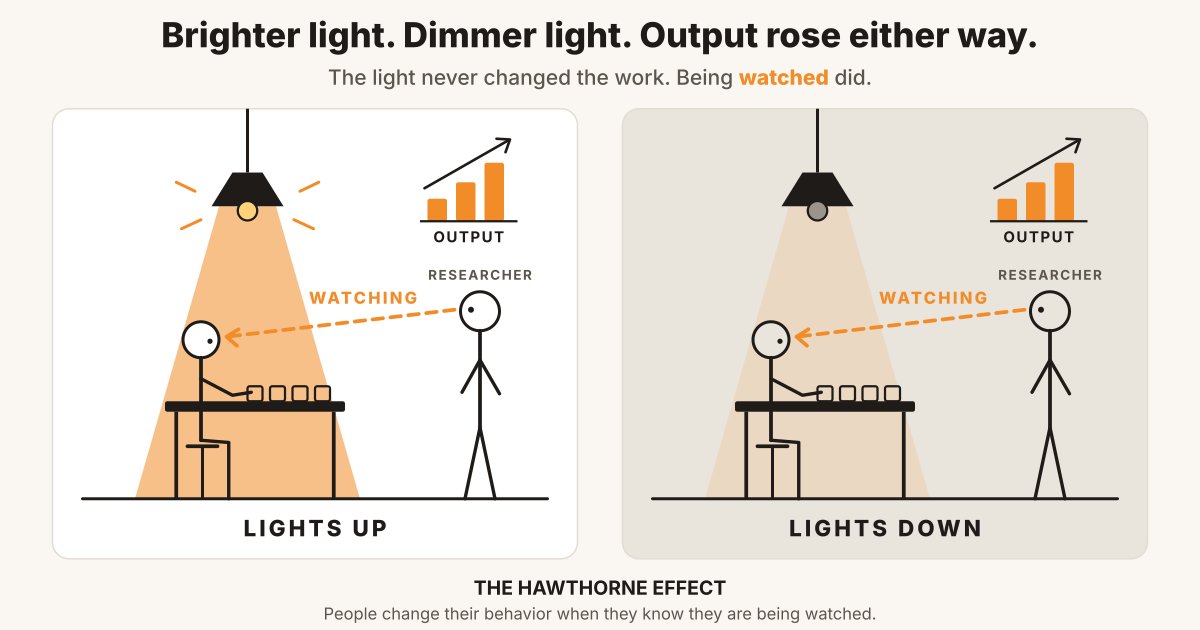
The Hawthorne effect in one picture
Bright lights or dim lights, output went up. The variable that mattered wasn't on the ceiling. It was the person standing in the room with a clipboard.
Where the Hawthorne effect came from
In November 1924, researchers kicked off a series of experiments at the Hawthorne Works, a Western Electric factory in Cicero, Illinois, just outside Chicago. This wasn't some corner shop. It was a small city that built telephone equipment for the Bell system, with its own hospital, library, and ballpark. By the end of the decade, it employed 40,000 people.
The question was simple, and it was about money: does better lighting make workers more productive?
The electric industry wanted the answer to be yes. Brighter bulbs, more productive workers, factories buying more bulbs. Follow the money. So the industry sponsored the National Research Council to run the tests.
Researchers turned the lights up. Output rose.
They turned the lights down. Output rose again.
That's the version that landed in every textbook: no matter which way the lighting moved, even when the room got darker, productivity climbed.
Then came act two. From 1927 to 1932, a small group of women who assembled telephone relays was moved into a separate test room. Researchers, eventually including Harvard's Elton Mayo, fiddled with everything: rest breaks, workday length, pay incentives. And they watched those women constantly, recording every single relay.
Output kept climbing, change after change.
The conclusion that stuck? The lighting never mattered. The breaks barely mattered. What mattered was that these workers knew they'd been singled out. They knew someone was watching.
How the Hawthorne effect got its name
Here's the kicker: nobody at that factory ever called it the Hawthorne effect.
The studies wrapped up in the early 1930s. Researcher John R. P. French put the phrase in print in 1953, and sociologist Henry Landsberger made it famous in 1958 when he took a second look at the Hawthorne findings. From there it marched into every management and psychology textbook on the planet.
The name stuck to the factory. The lesson stuck to the rest of us.
Is the Hawthorne effect real?
Now, before you start screaming that the Hawthorne effect is a myth... you're half right.
For decades, the original lighting data were believed destroyed. Then economists Steven Levitt and John List dug them out of university archives and ran the numbers. Their verdict, published in 2011: the dramatic textbook story didn't hold up. Productivity did not reliably jump every time someone touched the lights.
One culprit was hiding in plain sight. Researchers changed the lights on Sundays, when the plant was closed, and measured the results on Monday, a day when workers were already more productive whether anyone was studying them or not.
But Levitt and List didn't bury the idea. They also found subtler signs that being studied did nudge output, especially when the experimenters themselves made the changes.
So what's the takeaway? The famous factory story is shakier than your textbook let on. The principle behind it isn't. Being watched changes behavior, and you've felt it yourself every time someone looked over your shoulder.
Why the Hawthorne effect works on you
Being watched hits your brain three ways at once.
- It raises the stakes. Someone's going to see the result, which means your reputation is on the line.
- It kills the private negotiation. Alone, "I'll do it tomorrow" is a deal you cut with yourself, and you approve it every single time. With a witness, that excuse has to survive a second opinion.
- It turns effort into a scoreboard. Once someone's keeping score, progress becomes visible, and nobody likes losing on a scoreboard.
Most people treat this as a character flaw. "If I really had discipline, I wouldn't need anyone watching me."
Wrong. That's normie thinking.
Every elite athlete trains under a coach's eye. Every CEO answers to a board. Every Olympian has a date circled on the calendar when the whole world finds out whether the work got done. They don't win on willpower. They engineer an audience.
The Hawthorne workers didn't choose to be watched. It was done to them, and their output climbed anyway.
You get to choose. Let that sink in.
Put the Hawthorne effect to work with Inspirited
The Hawthorne effect is free performance. It's about as close to a free lunch as human behavior gets, and most people leave it switched off for one reason: nobody's assigned to watch them.
No boss is watching your side business. No researcher with a clipboard is tracking your health, your writing, or the habit you swore you'd quit. So the promises you make to yourself live in the dark, and promises made in the dark are easy to break.
That's why I built Inspirited. It turns the lights on.
You declare the commitments that actually shape your life, including the "I will NOT" promises, like no drinking or no doom-scrolling. Each one comes due on the day you set. When it's due, you report whether you kept it. Kept or broken, it goes on the record. And you stake points on your promises, so breaking one actually costs you something.
You're not reporting into a void, either. I'm your accountability partner. And AI MJ, trained on all four of my books and more than 70,000 high-impact posts from The Fastlane Forum, is there to coach you through the decisions behind each promise.
The Hawthorne workers got watched by accident. You can get watched on purpose, by someone who actually wants you to win.
Turn the lights on
- Pick one commitment that matters. The one tied to the person you want to become, not the one that's easiest to check off. For example, walk 10,000 steps a day.
- Give it a due date. A promise without a date is just a wish.
- Put a witness on it. A partner, a group, or Inspirited.
- Report the result when it comes due. Kept or broken. The broken ones teach you the most.
- Repeat until the watched version of you becomes the normal version.
Alone, you perform for your excuses. Watched, you perform for your future.
Let attention drive intention.
MJ DeMarco, Founder
What this looks like on Inspirited
I will walk 10,000 steps per day for the next week.

 Ada: 2 down, 5 to go. Keep it up. 💪 2
 Noor: I put 5 Spark on you. Don't make me lose it. 😂 1
 Silas: I made the same promise last month. The middle days are the hardest. 👍 3
Read next
Keep your next promise.
Real people, real stakes on your word.